What was ActionPPE? The 2020–21 group-buying collective, on the record
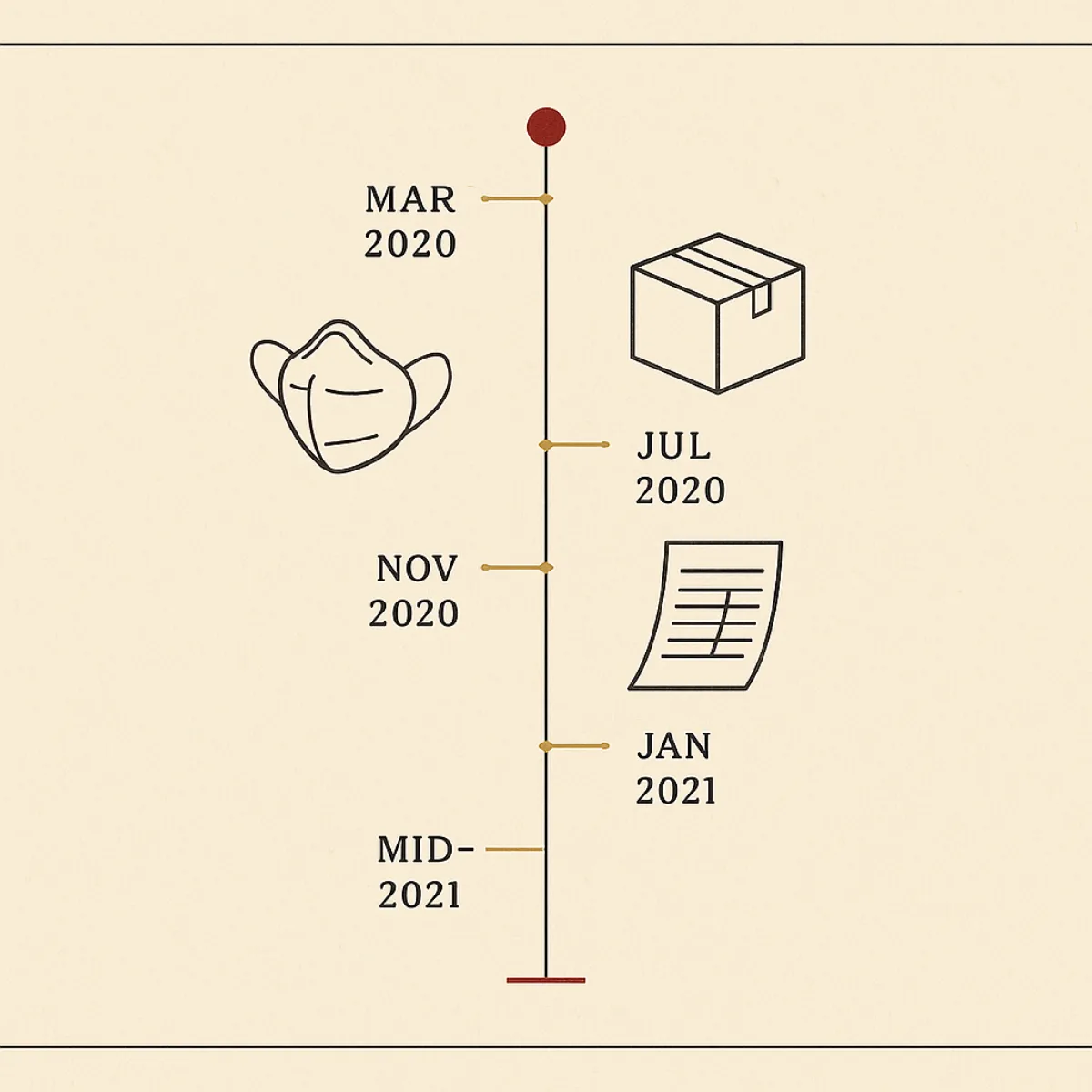
From March 2020 until roughly mid-2021, the address actionppe.org belonged to a doctor-led PPE group-buying collective founded by the Charleston County Medical Society of South Carolina. A press release dated January 6, 2021 — preserved in a Wayback Machine capture from January 15, 2021 — states that the program had by then shipped over 3.4 million units of personal protective equipment to 2,606 practices representing more than 10,000 doctors. That program ended in 2021. This page is the record of what it was, assembled from dated archive captures and contemporaneous coverage.
The short answer
Readers still arrive here from 2020-era links on medical-society websites, directory listings, and trade coverage, and the question those links raise is simple: what was this site, and what happened to it? The group-purchasing program that operated at this address stopped adding products in mid-2021, sat frozen for roughly three years, and the domain later changed hands. The present site is an independent publication that documents the program's history and maintains a practical PPE reference. A practice that came here looking for a 2026 source of respirators will find the useful successor question — who is trustworthy now that the pandemic-era purchasing programs are gone — answered in Where the pandemic PPE purchasing programs went.
Founding: a county medical society builds a buying collective
The founding story is best preserved in the program's own formation press release, dated January 6, 2021 and captured by the Wayback Machine on January 15, 2021. (The release's dateline reads "January 6, 2020," but this is a typo: the surrounding page and its January 2021 events date it unambiguously to 2021 — the kind of small archival wrinkle worth stating rather than silently correcting.)
According to that release, the Charleston County Medical Society (CCMS) of Mt. Pleasant, South Carolina founded ActionPPE in March 2020, during the first wave of COVID-19. The problem it was built to solve was distributional: demand for PPE had spiked, and the traditional distributors were prioritizing large practices and hospital systems, leaving solo practitioners and small independent offices at the bottom of the supply chain. The release describes the society's president and a handful of its physician members working their contacts to locate supplies, and eventually connecting with an international management consultant who had import-export experience and contacts at FDA-registered PPE factories in China.
The speed the release claims is notable: within about ten days of founding, an e-commerce site was launched and an email went out offering every physician in South Carolina the chance to order through the collective. That first email, the release states, brought in over $50,000 in orders. Expansion followed the same pattern — the society leveraged peer relationships with medical societies in other states, beginning with Arizona, West Virginia, and Pennsylvania. By the time of the January 2021 release, nine months after launch, it claimed participation from over 40 state and national medical and related associations.
The Pennsylvania partnership left an independently dated trace: a PR Newswire release of July 6, 2020 announced that the Pennsylvania Medical Society had partnered with ActionPPE to expand PPE access, noted that the partnership had begun in late April 2020, reported over 200 orders placed since then, and stated that the medical society received no compensation for the arrangement. The same release recorded why demand existed: roughly 20 percent of surveyed Pennsylvania physicians said their facilities had less than one week of PPE in stock.
The formation release also documents the economics of the arrangement on the society's side. CCMS received 5 percent of order value, which the release says funded five $2,000 merit-and-need scholarships for students at the local medical university; surplus PPE was donated to free clinics and homeless shelters. The rationale offered for the whole model was a market-size argument: the release cites a figure of 415,000 independent physicians nationwide — individually too small for distributors to prioritize, collectively a buying bloc approaching hospital-system scale.
How the buying actually worked
Archived captures of the storefront show the mechanics plainly. The store itself was a WordPress and WooCommerce site living under the path /3/, with a co-branded order page for each participating society at /3/<slug>/ — the society's name in the page title, a product table, and a checkout form that asked buyers which organization could be thanked for their purchase. A capture of the North Carolina Medical Society's page from September 19, 2020 shows the format: a group-buying headline, a $250 minimum order, and a five-product table — KN95 masks at $2.68 each, disposable tri-fold masks at $0.49 each, polypropylene isolation gowns, full-back disposable gowns, and reusable face shields marked as made in the USA. Nitrile exam gloves appeared on later captures.
The product standards on those pages reward a careful reading. The KN95 listings cited the Chinese standard GB2626-2006 (later captures show GB2626-2019), described the masks as near-equivalent to a NIOSH N95, and reported a program-tested filter efficiency above 98 percent — the program's own claim, on its own storefront. A KN95 is certified under a Chinese national standard, not approved by NIOSH under 42 CFR Part 84, and the distinction — cosmetic-sounding in 2020, consequential for any workplace respiratory-protection program — is taken apart in N95 vs KN95 vs surgical mask.
The aggregation model was the entire point, and contemporaneous reporting captured it well. The Post and Courier of Charleston, reporting on January 10, 2021, described the collective's premise as aggregate buying power — a single practice's order is too small for a vendor to notice, so orders were bundled until they were large enough to command attention and price — and noted that the effort had grown from a handful of Charleston physicians into a company with a few employees. The program advertised savings of 20 to 50 percent against small-order prices; that figure appears in the formation press release, in the Post and Courier's account, and on archived homepages, and it should be read as the program's own claim, repeated by outlets quoting the program, rather than as an independently audited number.
The reach beyond physicians is also documented. Orthodontic Products reported on January 7, 2021 that the collective had opened to dental colleagues in South Carolina early in the pandemic, that a free dental clinic was among the earliest recipients of the project's pro bono help, and that the Maine Dental Association was at that point the only dental organization among the 40-plus participating associations — individual dental practices could join even where their state association had not.
The N95 group buys
The program's most structurally interesting operation was its late-2020 push to get genuine NIOSH-approved N95 respirators — as distinct from KN95s — into independent practices. A capture from November 5, 2020 preserves the offer: ActionPPE, partnered with the Wisconsin Medical Society and other associations, would procure 500,000 Honeywell H910 Plus N95 respirators at $3.85 each, placing the factory order only once 500,000 units had been pledged. Orders closed November 23, 2020; shipping was to begin December 14, 2020 by FedEx Ground; if the goal was not reached, orders would be refunded. A "Second Series" followed in early 2021, with the order to be placed February 25.
The respirator itself is checkable in a way most pandemic-era PPE was not. The archived listing gives the NIOSH approval number TC-84A-8480, and Honeywell's technical data sheet for the H910 Plus carries the same approval under 42 CFR Part 84. Any TC number can be resolved against the live NIOSH Certified Equipment List — the single most durable skill the group-buy era left behind, and the subject of How to verify a respirator is really NIOSH-approved. The full story of the group buys — the pricing context, the deadlines, what half a million units meant in the late-2020 market — is told in How doctors got real N95s in late 2020.
The numbers, as the program stated them
No independent audit of the program's shipment volumes is known to exist. What the record preserves is a sequence of the program's own claims, each attributable to a dated capture, and their internal consistency is itself informative: the numbers grow through mid-2021 and then stop growing.
| As of | Claim | Where it appeared |
|---|---|---|
| January 6, 2021 | Over 3.4 million units shipped to 2,606 practices representing 10,000+ doctors | Formation press release (capture of January 15, 2021) |
| January 2021 | More than 3 million units of FDA-certified PPE to physicians in 40 states | Site footer boilerplate (same capture) |
| April 2021 | More than 5 million units shipped | Homepage (capture of April 21, 2021) |
| November 2022 | "Over 5M Units of PPE Shipped" — unchanged from 2021 | Homepage headline (capture of November 30, 2022) |
The jump from 3.4 million units in January 2021 to more than 5 million by April 2021 brackets the program's peak quarter — the winter wave, and the window of both N95 group buys. That the 5-million figure then sits unchanged on the November 2022 homepage is the quiet tell of the wind-down: the storefront was still online, but the counter had stopped.
Two other artifacts round out the program's public record from its peak. Its formation release was syndicated into trade press — Biospace, a biotech news site, carried it, as a capture from January 16, 2021 confirms — which is why directory-style links to "ActionPPE.org" still dot medical-trade pages. And on January 21, 2021 the program issued a second release, captured on March 3, 2021, reporting a survey of 1,000 U.S. adults in which 80 percent said healthcare providers should continue wearing PPE after the pandemic and 51 percent said they would pay more for office visits to ensure it — a snapshot of how confident the PPE economy still felt at the January 2021 peak.
The website's three eras
The site's architecture changed three times during the program's life, and the captures date each era.
The brochure era (May–late 2020). From the earliest capture on May 10, 2020 through at least November 2020, the root URL did not serve a page at all: the Wayback Machine's index shows it returning a 303 redirect to /2, a static brochure site. A capture of that brochure from July 21, 2020 describes the initiative as a Charleston County Medical Society launch built to put member physicians in touch with a bulk PPE supplier the society had vetted, states that products were restricted to qualified medical personnel and barred from resale, and carries the era's mission-and-testimonials furniture.
The storefront era (June 2020 onward). The WooCommerce store at /3/ came online in June 2020 — the earliest captured partner page dates to June 22, 2020 — and grew a co-branded order page per society. Some twenty partner slugs appear in the archive's index, from state medical societies to osteopathic and specialty associations; the fullest accounting of who participated, what each storefront carried, and when, is the registry at The medical societies that ran PPE programs. The program also ran a short-lived blog in this era; a September 2020 post claimed that roughly 90 percent of U.S. PPE was imported, most of it from China — the supply-chain anxiety that was the program's entire reason to exist.
The marketing-site era (January 2021 onward). From mid-January 2021 the root URL served a proper homepage — story, partner states, impact figures, press releases, and an application page for new associations. This is the site most 2021 visitors saw, and the one whose homepage counter froze at 5 million units.
The program, dated
- March 2020 CCMS founds ActionPPE during the first COVID-19 wave; per the formation release, the e-commerce site launches within about ten days and the first outreach email brings in over $50,000 in orders.
- Late April 2020 The Pennsylvania partnership begins, per the July 2020 PR Newswire release; Arizona and West Virginia are among the first partner states.
- May 10, 2020 Earliest Wayback capture: the root URL redirects to the
/2brochure site. - June 2020 The WooCommerce storefront at
/3/comes online; first captured co-branded society page June 22. - September 2020 Captured NCMS storefront shows the mature format: $250 minimum, KN95s under GB2626-2006, gowns, shields, tri-fold masks.
- November 2020 First N95 group buy: 500,000 Honeywell H910 Plus respirators (TC-84A-8480) at $3.85 each; orders close November 23, shipping from December 14.
- January 2021 Formation and survey press releases; root marketing site goes live; claimed totals reach 3.4 million units, 2,606 practices, 40+ associations.
- February 2021 Second Series N95 group buy; the order was to be placed February 25.
- April–June 2021 Homepage claim reaches 5 million units; the last new products are vaccination-era supplies — syringes and needles — in June 2021.
- August 2021 Last new partner page captured. Content creation stops.
- 2022–2023 The site sits frozen and essentially unchanged; the November 2022 homepage still claims "Over 5M Units."
- February 2024 Store pages still technically resolve — the last trace of the original site.
- July 2024 The lapsed domain reappears serving unrelated spam content.
The wind-down, the freeze, and the domain's later years
No shutdown announcement was ever captured, and honesty about that gap matters: the end of ActionPPE is an inference from the archive's silence, not a documented event. The evidence pattern is consistent, though. The last new products — vaccination supplies, a pivot that itself dates the moment — appear in June 2021, as the vaccine rollout eased the PPE shortage that had created the program. The last new partner page was captured in August 2021. After that, nothing: the site persisted online, unchanged, through 2022 and 2023, its storefront pages still technically resolving as late as February 2024. The reasonable reading of the record is an operating life of March 2020 to mid-or-late 2021, followed by a roughly three-year frozen tail.
This trajectory was not unique to ActionPPE — it is the shape of the entire pandemic-era ad-hoc purchasing sector. Project N95, the national nonprofit clearinghouse, announced its own wind-down effective December 18, 2023, after distributing some 37 million units. The society-run group buys froze earlier and more quietly, but for the same reason: the emergency demand that justified improvised channels evaporated, and PPE purchasing folded back into ordinary distributors and group purchasing organizations. That larger story, and what a practice should do with it in 2026, is the subject of Where the pandemic PPE purchasing programs went.
One final chapter belongs to the record because a reader with an old bookmark may have seen it: after the domain lapsed, it spent roughly July 2024 through 2025 serving an auto-generated spam blog with no connection to PPE, medicine, or the original program — content this publication records only to date it, and which has been removed from this address.
What this address is now
ActionPPE is now an independent publication. The 2020–2021 group-purchasing program that operated at this address ended in 2021; what operates at the address now is its record. Historical descriptions on this page are drawn from archived captures and cited coverage. The publication keeps the name because the name is what the surviving links, citations, and society announcements point to: it is the handle on a real episode in the history of American medical practice, and the episode deserved a durable account.
The site's two wings follow from that. The Record — this page and its siblings on the partner societies, the N95 group buys, and where the programs went — preserves what happened, dated and sourced. The Reference carries forward what the episode taught: how to verify a NIOSH approval, what the mask standards actually certify, whether stockpiled respirators from 2021 are still usable, and how much a small practice should keep on hand so the next shortage finds it less exposed than the last one did. A short orientation to the N95 questions specifically lives at /n95/, the path the group buys once occupied.
Primary sources
- Formation press release, "Charleston County Medical Society Forms Buying Group to Help Doctors Get Essential PPE," dated January 6, 2021 — Wayback Machine capture, January 15, 2021.
- Survey press release, January 21, 2021 — Wayback Machine capture, March 3, 2021.
- Biospace syndication of the formation release — Wayback Machine capture, January 16, 2021.
- The Post and Courier, "An SC doctors' group banded together to crack its PPE problem. The idea caught on." — January 10, 2021.
- Orthodontic Products, "Doctor-Led Collective Buying Group ActionPPE Gives Dental Professionals Access to Needed PPE" — January 7, 2021.
- PR Newswire, "Partnership increases access to personal protective equipment for health care workers in Pennsylvania" (Pennsylvania Medical Society) — July 6, 2020.
- Wayback Machine captures of actionppe.org: root redirect index entries from May 10, 2020; /2 brochure, July 21, 2020; /3/ncms/ storefront, September 19, 2020; N95 group buy, November 5, 2020; homepage, April 21, 2021; homepage, November 30, 2022.
- Honeywell H910 Plus (N95) technical data sheet — NIOSH approval TC-84A-8480 under 42 CFR Part 84.
- NIOSH Certified Equipment List — wwwn.cdc.gov/niosh-cel, the live registry for any TC approval number.
- Project N95 wind-down notice, effective December 18, 2023 (projectn95.org/winding-down).