How to verify a respirator is really NIOSH-approved: TC numbers, the CEL, counterfeit red flags
When U.S. medical societies pooled orders through this address in November 2020 for 500,000 Honeywell H910 Plus respirators, the line on the order page that carried all the weight was a short printed code: TC-84A-8480. That code — a NIOSH testing and certification approval number — was, and remains, the difference between a respirator and a shaped piece of fabric. The verification skill has not changed since: read the number off the mask, look it up in NIOSH's Certified Equipment List, and believe the database rather than the box. This article walks through the check step by step, using NIOSH's own published criteria.
What "NIOSH Approved" actually means
"NIOSH Approved" is a specific legal state, not a marketing phrase. The National Institute for Occupational Safety and Health tests and approves respirators for U.S. workplace use under 42 CFR Part 84, and its publication 2021-124, How to tell if your N95 respirator is NIOSH approved, describes what the approval certifies: in NIOSH's filtration test, an N95 is challenged with a near worst-case penetrating aerosol size and must not allow more than 5% of those particles through. The filter class printed on an approved respirator is a two-axis code — a letter for oil resistance (N, R, or P) and a number for minimum filtration efficiency (95, 99, or 100) — so an N95 and a P100 are points on the same certified scale, not competing brands.
The approval matters legally as well as technically. When respiratory protection is required in a workplace, OSHA's respiratory protection standard, 29 CFR 1910.134, requires NIOSH-certified respirators — a point NIOSH's 2025 counterfeit fact sheet (publication 2025-105) states directly. This is why a KN95, certified to the Chinese standard GB 2626-2019, cannot satisfy a required-use program regardless of how well it filters: it carries no NIOSH approval to verify. The distinctions between the three mask families are covered in N95 vs KN95 vs surgical mask; whether a required-use program applies to a small office is covered in the OSHA respiratory protection article.
Two consequences of the legal framing are worth fixing in mind before the walkthrough. First, per NIOSH publication 2021-124, an approval applies to the respirator exactly as tested: any modification — by a manufacturer changing a strap attachment, by an unauthorized third party, or by a wearer drawing on the facepiece — voids it. Second, approvals are time-varying. NIOSH revokes and rescinds approvals, removes them from the Certified Equipment List when it does, and announces the change in Respiratory Protective Device Information notices. A box that verified in 2021 is not automatically verified in 2026.
The required markings, one by one
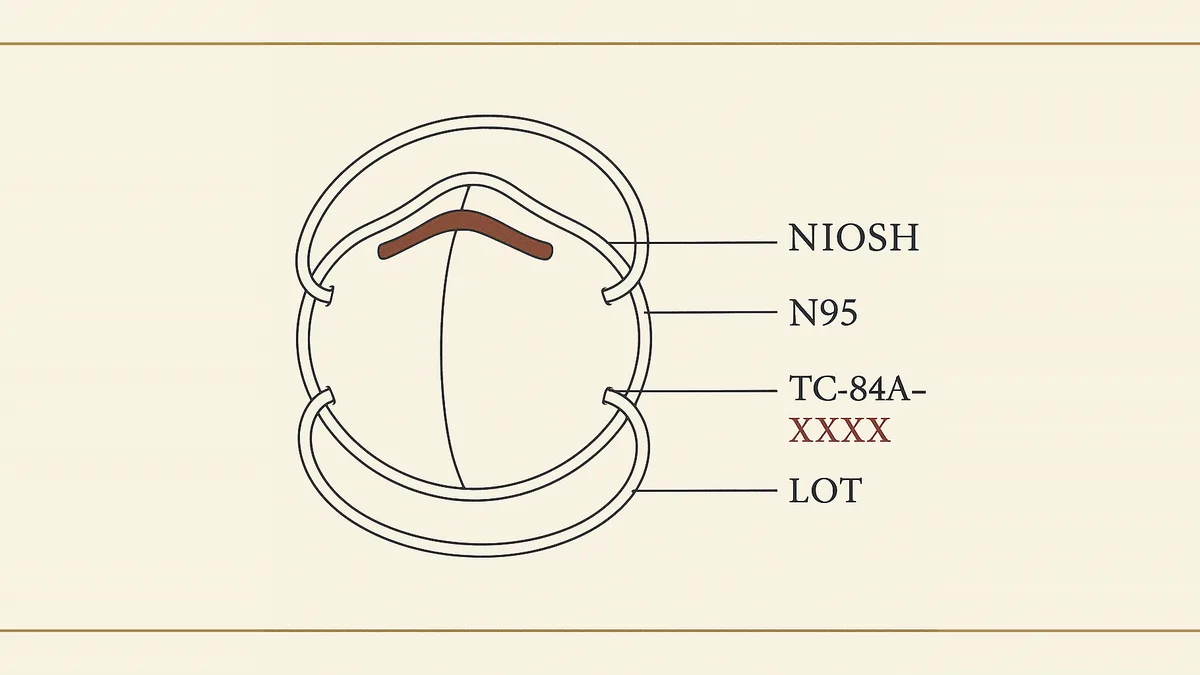
NIOSH publication 2021-124 and the 2025 fact sheet together specify what must be printed on an approved filtering facepiece respirator. If any required element is missing, NIOSH's own language is categorical: it is not a NIOSH-approved respirator. The table below is the checklist, as of the publications' text.
| Marking | Where it appears | Notes |
|---|---|---|
| Approval holder or manufacturer business name | Facepiece | If the respirator is private-labeled, the private-label name or logo appears instead; the CEL links the two. |
| Part number | Facepiece | Per NIOSH 2021-124, the part number — not the model name — is the most accurate way to identify a particular respirator. |
| Filter series and efficiency level | Facepiece | N95, N99, N100, R95, R99, R100, P95, P99, or P100; "Surgical N95" where that designation applies. |
| TC approval number | Facepiece or strap | Format TC-84A-XXXX for filtering facepieces; this is the number the CEL is keyed on. |
| NIOSH in capital block letters | Facepiece | A misspelling of NIOSH is one of the agency's listed counterfeit signs. |
| Lot number | Facepiece, packaging, or user instructions | Per the 2025 fact sheet: recommended but not required, and its location may vary. |
The TC number deserves a moment of anatomy. "TC" stands for testing and certification; the middle segment is the approval schedule — 84A for particulate respirators approved under 42 CFR Part 84, with other schedules such as 23C covering chemical cartridge respirators; the final digits are the sequential approval. So TC-84A-8480 reads: a Part 84 particulate approval, number 8480 in the series. Filters and cartridges sold for elastomeric respirators carry their own required markings — approval holder, part number, the acronym NIOSH, and the protections or filter series such as P100 — a detail that matters because NIOSH's 2025 fact sheet reports many counterfeit "P100" cartridges on major online marketplaces.
Checking a TC number on the Certified Equipment List
The NIOSH Certified Equipment List, at wwwn.cdc.gov/niosh-cel, is the official listing of every NIOSH-approved respirator, maintained by NIOSH's National Personal Protective Technology Laboratory. NIOSH publication 2021-124 calls searching it the easiest way to tell whether an N95 is approved, and states the decisive rule plainly: if a TC approval number returns no result in the CEL, it is not a valid approval number and the product is not NIOSH-approved. The check, end to end:
- Read the TC number off the respirator itself — the facepiece or, on some models, a strap. Not the box, not the listing: per NIOSH 2025-105, the approval number is required to appear on the respirator. A box printed with an approval number wrapped around unmarked masks is its own red flag.
- Open the CEL and search by approval number. The search field takes the approval code and digits — for a filtering facepiece, the portion after "TC-", in the form 84A-XXXX — and accepts multiple numbers separated by semicolons, which makes checking a mixed delivery fast.
- Match everything, not just the number. A result confirms the approval exists; the entry's approval holder, part number, and filter class still have to match what is printed on the respirator in hand. A genuine TC number stenciled on a different product is a known counterfeiting pattern — NIOSH's counterfeit listings include exactly this mismatch.
- Check for private labels. The CEL identifies alternate brand names sold under the same approval, which resolves the common puzzle of a legitimate respirator whose brand name matches nothing on the box of the "same" model bought last year.
- Mind the obsolete toggle. The CEL's search offers an option to include obsolete approvals. Approvals age out and get revoked; a respirator whose approval only surfaces as obsolete is no longer NIOSH-approved, however genuine it was when made. Revocations are removed from the active list and announced through NIOSH's conformity assessment notices.
For anything that resists a clean lookup, NIOSH also maintains supplier lists of all approved filtering facepieces by type and model, and the CEL search can filter by manufacturer, approval schedule, facepiece type, and approval date range. The tool is built for specialists, but the single-number lookup is a one-minute skill any practice manager can run at the point of delivery — the modern form of the check that the 2020 group buys performed upstream, described in the Record's account of the 500,000-unit N95 buys.
Counterfeit red flags: the product, the listing, the seller
The scale of the problem is documented, not anecdotal. CDC reported that roughly 60% of the KN95 respirators it evaluated in the United States during 2020–2021 were counterfeit — a figure reported widely in early 2022 and cited in congressional correspondence urging Justice Department action against mask fraud. And the problem did not end with the emergency: NIOSH issued a new fact sheet on counterfeit and misrepresented respirators in 2025 (publication 2025-105, announced in June 2025), and NIOSH's January 2026 eNews reported the agency had investigated 4,163 potentially fraudulent respirator listings, identifying 1,245 fraudulent listings since May 2025 — 260 of them on everyday, highly visible online marketplaces, of which 189 were removed.
NIOSH's 2025 fact sheet draws a distinction worth keeping: counterfeit respirators copy an actual NIOSH-approved model, while misrepresented respirators are simply marketed as approved when they are not. Both fail the CEL check; they fail it differently. A counterfeit may carry a real TC number that verifies — which is why step 3 above compares the whole entry — while a misrepresented product typically carries no valid number at all.
On the product itself, NIOSH publication 2021-124 lists the signs that an "N95" may be counterfeit:
- Missing any of the required label markings described above;
- NIOSH spelled incorrectly;
- Decorative fabric or add-ons such as sequins;
- Claims of approval for children — NIOSH does not approve any respiratory protection for children;
- Ear loops with no fastener connecting them behind the head. NIOSH-approved designs use two head bands — crown and neck — or ear loops approved for use with a connecting fastener.
On the listing and the seller, the 2025 fact sheet adds the purchasing-side signals: NIOSH encourages buying from authorized distributors rather than third-party marketplaces or unfamiliar websites, and advises skepticism toward listings that lean on the words "legitimate" and "genuine", highlight part numbers while avoiding the approval holder's name, advertise unlimited stock during shortages, or swing prices frequently. For standalone websites, the fact sheet flags contact addresses on free mail services rather than the site's own domain, misspelled domain names, and the general tells of a hastily assembled storefront — typos, broken links, blank pages. For filters and cartridges, it warns specifically against claims that a third-party filter or cartridge "works with" a NIOSH-approved respirator: an approval covers a tested configuration, and an unapproved cartridge on an approved facepiece is not an approved respirator.
When a box fails the check
A respirator that fails verification cannot be used to satisfy a required-use program under 29 CFR 1910.134, whatever its actual filtration performance, because the standard requires NIOSH-certified equipment. NIOSH asks that suspected counterfeit or misrepresented devices be reported to the agency; publication 2025-105 lists the reporting contact and the details to include — the company name on the respirator, model or part number, photos of the product and packaging, the claimed TC number if present, and the URL where it was purchased. NIOSH posts confirmed counterfeits and misrepresentations on its counterfeit respirators page, with photographs, which is also the place to check a suspicious product someone else has likely already encountered. Suspect stock is not worthless, but its remaining honest uses are narrow — the same uses NIOSH and state agencies assign to expired stock, covered in Do N95s expire?
Is NIOSH approval still functioning? Status as of August 2026
A verification workflow is only as good as the institution behind the database, and in 2025–26 that institution became a story of its own. The sequence, from the public record: in spring 2025, an HHS restructuring cut roughly 870 NIOSH positions. In May 2025, HHS told the House Appropriations Committee it had reinstated 328 employees, including the Respirator Approval Program and the Coal Workers' Health Surveillance Program. In January 2026, the American Federation of Government Employees announced that the federal government had revoked the remaining 2025 layoff notices for NIOSH staff.
Through that turbulence, the approval program's measurable output improved rather than stalled. NIOSH's January 2026 eNews reported that average application processing time fell from 100 days in 2024 to 65 days from mid-May 2025 onward — a 35% reduction — and that NIOSH granted 528 new respirator approvals in 2025. The same issue reported the market-surveillance figures cited above, which is evidence the counterfeit-policing side of the program is active, not just the approval side.
Guidance in flux — checked August 2026
The HHS budget-in-brief for fiscal year 2027, published April 3, 2026, proposes folding NIOSH into a new National Center for Chemicals and Toxins within CDC; the proposal names the Respirator Approval Program among the functions the new center would retain. That is a pending budget proposal, not an enacted reorganization, and how Congress resolves it is unknown as of this writing. What is settled: the approval program is operating, approvals are being granted, and the live record of what is approved remains the NIOSH Certified Equipment List, wherever the program sits on an organization chart.
What a verified approval does not tell you
A TC number that verifies establishes that the design was tested and approved. It does not establish that a particular respirator will protect a particular wearer. NIOSH publication 2021-124 conditions its own assurance: an approved respirator works as expected as long as it is properly maintained, worn and used correctly, fits properly, and is replaced as the manufacturer recommends. Fit is the largest of those variables and has its own machinery — fit testing under 29 CFR 1910.134(f), covered in the fit testing guide. Nor does an approval speak to age and storage: filter media and straps degrade, which is why shelf life is a separate question from authenticity.
Approval status itself is a snapshot. The CEL reflects revocations and obsolescence as they happen, so the check belongs at every reorder, not just the first one — a habit that costs a minute and removes the largest single uncertainty in respirator purchasing. Where this article states the status of the approval program, that status is dated August 2026 and sourced to the documents below; anything read later should be checked against the live CEL and NIOSH's current notices.
Primary sources
- NIOSH Certified Equipment List — the official, searchable listing of NIOSH-approved respirators (search by approval number, manufacturer, schedule, facepiece type, and date, with an obsolete-approvals option).
- DHHS (NIOSH) publication 2021-124, How to tell if your N95 respirator is NIOSH approved (September 2021) — required markings, counterfeit signs, alteration and revocation rules.
- DHHS (NIOSH) publication 2025-105, Informing Workers of Counterfeit and Misrepresented Respirators (April 2025, announced June 2025) — counterfeit vs misrepresented, filter and cartridge markings, marketplace and website red flags, reporting details.
- NIOSH eNews, January 2026 — approval processing time 100 → 65 days, 528 approvals granted in 2025, and the 4,163 / 1,245 / 260 / 189 market-surveillance figures.
- NIOSH Respirator Approval Program — program hub, conformity assessment notices, and counterfeit listings.
- CDC's 2020–2021 evaluation finding that about 60% of KN95 respirators in the U.S. were counterfeit — reported in contemporaneous national coverage and cited in February 2022 congressional correspondence to the Department of Justice.
- Coverage of the 2025 NIOSH staffing cuts and reinstatements: Safety+Health magazine (National Safety Council), 2025–2026; American Federation of Government Employees announcement, January 2026; HHS FY2027 Budget in Brief, April 3, 2026.
- Wayback Machine capture, November 5, 2020, of this domain's N95 group-buy page, listing the Honeywell H910 Plus under approval TC-84A-8480.