Does a five-person dental or medical office need an OSHA respiratory protection program?
When the medical-society group buys arranged through this address shipped their Honeywell N95s in December 2020, thousands of small practices took delivery of NIOSH-approved respirators — and, with them, a question most had never needed to answer: does an office of five people now owe OSHA a written respiratory protection program? The answer sits in 29 CFR 1910.134, and it turns on a distinction drawn in the standard's opening paragraphs: not whether N95s sit in the supply closet, but whether anyone is required to wear one. This article walks the standard's text, OSHA's Small Entity Compliance Guide, and the American Dental Association's fit-test guidance through the situations a small practice actually faces.
The short answer: use decides, not inventory
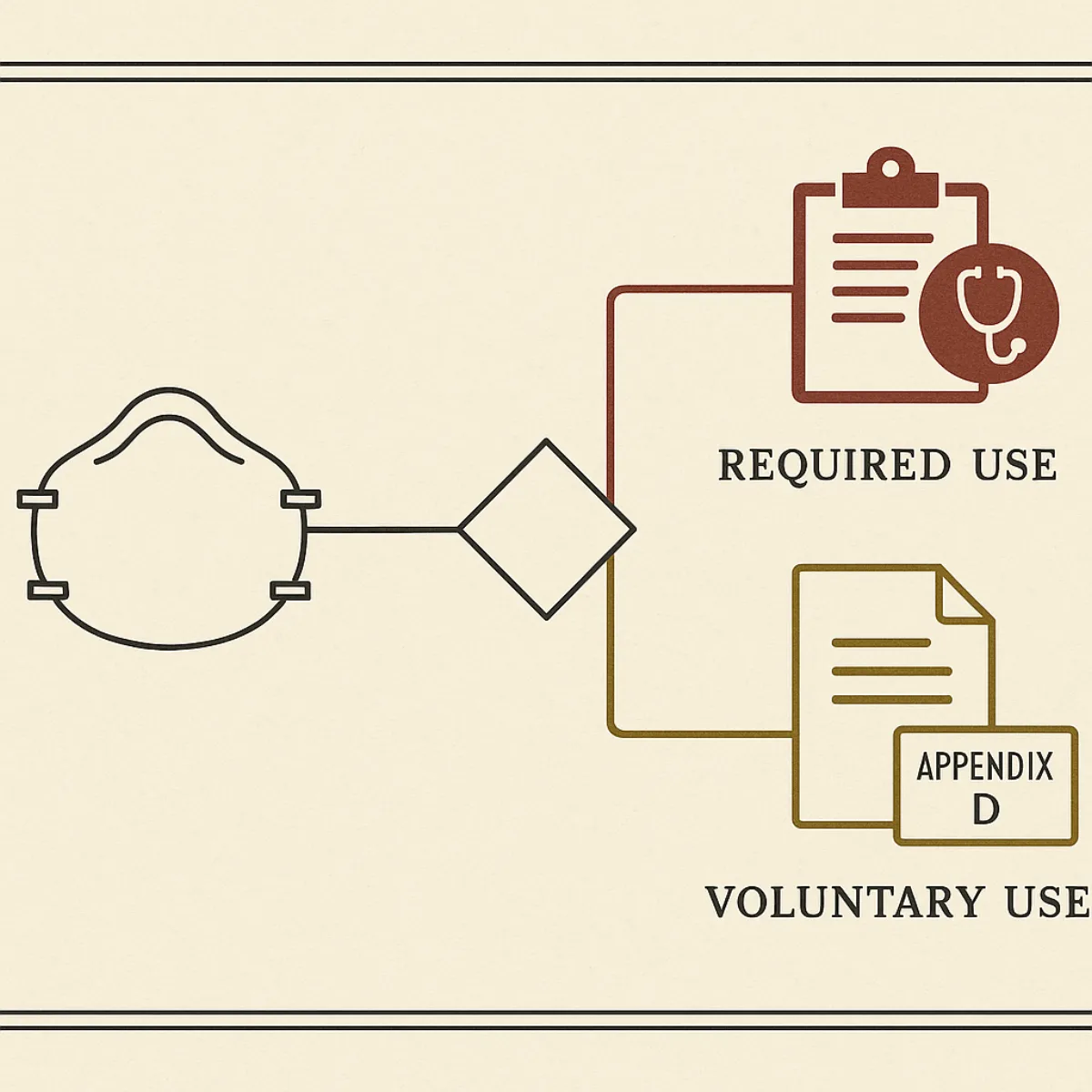
Nothing in 29 CFR 1910.134 is triggered by owning respirators. The standard's obligations attach to use, and they split into two lanes. Paragraph 1910.134(c)(1) sets the trigger for the full program: "in any workplace where respirators are necessary to protect the health of the employee or whenever respirators are required by the employer, the employer shall establish and implement a written respiratory protection program with worksite-specific procedures." Paragraph (c)(2) covers the other lane — "where respirator use is not required" — and asks far less: an employer permitting voluntary use must determine that the use itself creates no hazard and hand each voluntary user the information in Appendix D of the standard.
So the reader question — "are we out of compliance if we stock N95s?" — dissolves on the standard's own terms. A case of respirators in the closet obligates no one. The obligations begin the day someone puts one on, and their size depends on whose idea it was: the employer's policy or hazard assessment (full program), or the employee's own preference (Appendix D, with one exception below). OSHA's Small Entity Compliance Guide — publication 3384, written for exactly this audience — answers the small-office case directly: asked whether a written program is needed when only voluntary users wear respirators, it says "No, if the only respirators being worn voluntarily are filtering facepieces (dust masks)." An N95 is a filtering facepiece.
What counts as a respirator — and what does not
The standard governs respirators, so the boundary of the word matters. A NIOSH-approved N95 filtering facepiece — approved under 42 CFR Part 84, marked with a TC approval number — is a respirator, and wearing one can trigger 1910.134. A surgical or procedure mask is not: it is a medical device cleared by FDA under 21 CFR 878.4040 for fluid resistance and source control, with no tested respiratory protection. A practice whose staff wear only surgical masks has no 1910.134 question at all. The full comparison of the three product families is in N95 vs KN95 vs surgical mask.
The boundary cuts the other way too. Where respirator use is required, 1910.134(d)(1)(ii) directs that "the employer shall select a NIOSH-certified respirator." A KN95, certified to the Chinese standard GB 2626-2019, carries no NIOSH certification, so it cannot satisfy a required-use program regardless of its actual filtration — the ADA's fit-test guidance notes that OSHA publishes no fit-testing guidance for KN95s at all. Verifying that a given box really is NIOSH-approved is its own skill, covered in how to verify NIOSH approval.
Five office situations, and what each one owes
The table maps the situations a small office actually encounters onto the standard's requirements, citing the paragraph that governs each.
| Situation in the office | Does 1910.134 apply? | What the employer owes |
|---|---|---|
| Staff wear surgical masks only; no respirators are worn | No | Nothing under this standard — a mask cleared under 21 CFR 878.4040 is not a respirator. |
| N95s are stocked for contingencies; nobody wears them | No | Nothing. The standard's triggers in 1910.134(c) attach to use, not inventory. |
| Employees choose to wear N95s; the practice does not require it | Voluntary-use provisions only | Determine the use itself creates no hazard and provide each user the Appendix D text, per 1910.134(c)(2)(i). No written program: (c)(2)(ii) exempts voluntary use of filtering facepieces. |
| Employees voluntarily wear elastomeric half-masks or PAPRs | Partial program | Written program elements covering medical evaluation and cleaning, storage, and maintenance, per 1910.134(c)(2)(ii); the employer pays for the medical evaluations, per publication 3384. |
| The practice requires N95s for any task — or hazards make them necessary | Full program | A written, worksite-specific program with every applicable element of 1910.134(c)(1): selection, medical evaluation, fit testing, use procedures, maintenance, training, and evaluation — all at no cost to employees, per (c)(4). |
The fourth row surprises practice owners. The filtering-facepiece exemption is written narrowly: the moment the voluntarily worn respirator is anything else — an elastomeric with P100 cartridges from the shortage years, say — a written program comes back into existence, scoped to medical fitness and hygiene, because per the compliance guide a dirty or poorly disinfected respirator can itself become the hazard.
When N95 use becomes "required" in a small practice
Required use arrives by two roads, and the second is easy to walk onto without noticing.
The first road is the hazard itself: 1910.134(a)(2) requires a respirator "when such equipment is necessary to protect the health of such employee," and (d)(1)(iii) obliges the employer to identify and evaluate respiratory hazards in the workplace. For most offices there is no measured chemical exposure to evaluate; the live version of this trigger is infectious-disease guidance. The clearest current example is measles: CDC's Interim Infection Prevention and Control Recommendations for Measles in Healthcare Settings call for respiratory protection at least as protective as a fit-tested NIOSH-certified N95 upon entry to the room of a patient with known or suspected measles, regardless of the worker's presumptive immunity — and state explicitly that such use belongs inside a full 1910.134 program. A practice in an outbreak area that plans to see, or even triage, a suspected measles patient is planning required use.
The second road is the practice's own policy. The trigger in (c)(1) reads "or whenever respirators are required by the employer" — so an infection-control manual that says "clinical staff wear N95s for aerosol-generating procedures" has created required use all by itself, whether or not any OSHA standard would have demanded the respirator. The sentence in the office manual, not the aerosol, is what obligates the written program, the medical evaluations, and the annual fit tests. A practice that adopted an N95 policy in 2020 and never built the paperwork behind it is in this lane already; the fix is either to build the program the policy requires, or to consciously rewrite the policy as voluntary.
Guidance in flux — checked August 2026
Which pathogens call for a respirator rather than a mask is the province of CDC's isolation-precautions guidance, and that guidance is mid-rewrite: the HICPAC advisory committee's draft revision of the 2007 Isolation Precautions guideline was returned by CDC for further work and remains unfinalized as of this writing. The measles recommendation above is current interim guidance. What is settled is the OSHA machinery: however CDC draws the pathogen lines, employer-required respirator use triggers 29 CFR 1910.134 in full. The live guidance is on CDC's infection-control pages.
The full program, element by element
If a practice lands in the required-use lane, 1910.134(c)(1) lists nine elements the written program must address "as applicable" — and for an N95-only office, several shrink to a paragraph or drop out (no atmosphere-supplying respirators, no breathing-air procedures). In the standard's order: respirator selection; medical evaluation; fit testing; procedures for routine and foreseeable emergency use; cleaning, storage, and maintenance schedules; breathing-air quality for atmosphere-supplying respirators; training on the hazards; training on use and maintenance; and regular evaluation of the program's effectiveness. Three of them carry nearly all the work in a small office.
The program administrator. 1910.134(c)(3) requires a designated administrator "qualified by appropriate training or experience that is commensurate with the complexity of the program." The Small Entity Compliance Guide is explicit that this is not a specialist hire: where workers use only a few types of relatively simple respirators against modest hazards, knowledge of the guide itself plus the manufacturer's materials "may be sufficient for you, or a designated employee, to serve as the program administrator." OSHA neither runs nor requires any particular administrator course. In a five-person office, the administrator is realistically the dentist, the physician-owner, or the office manager.
Medical evaluation, before anything else. The sequence is fixed by 1910.134(e)(1): the employer provides a medical evaluation "before the employee is fit tested or required to use the respirator in the workplace." Fit-testing first and evaluating later — a common shortcut when a fit-test vendor visits — inverts the standard. The evaluation itself is lighter than practices expect: a physician or other licensed health care professional (PLHCP) reviews a questionnaire whose mandatory content is set out in Appendix C of the standard, administered confidentially and during working hours. Only an employee whose answers flag a problem — a positive response to questions 1 through 8 of Section 2, Part A — must be given a follow-up examination, per 1910.134(e)(3). The written recommendation that returns to the employer says only whether the employee can wear the respirator and with what limitations; the medical details stay with the PLHCP. Evaluations recur not on a calendar but on the triggers in (e)(7), such as reported symptoms or observations made during fit testing.
Fit testing, annually. 1910.134(f)(2) requires a fit test before initial use, whenever a different facepiece size, style, model, or make is used, and "at least annually thereafter." The test must use the same make, model, style, and size the employee will actually wear — the ADA's guidance for dental offices, Conducting Respirator Fit Tests and Seal Checks, stresses that testing on a different mask "does not assure proper protection." For N95s the qualitative fit test (QLFT) is permitted, since (f)(6) allows QLFT for negative-pressure respirators needing a fit factor of 100 or less; the ADA notes dentistry mostly uses the qualitative method, with four OSHA-accepted agents — isoamyl acetate, saccharin, Bitrex, and irritant smoke, though only saccharin and Bitrex apply to a plain filtering-facepiece N95 (isoamyl acetate requires organic-vapor cartridges and irritant smoke requires P100 filters) — and a running time of roughly 15 to 20 minutes per person. Retests are also event-driven, per (f)(3): facial scarring, dental changes, cosmetic surgery, or an obvious change in body weight. Who runs the test, what it costs in 2026, and whether the annual interval is scientifically generous are covered in the fit testing guide.
The remaining machinery is smaller but real. A user seal check — the wearer's own positive- and negative-pressure check, described in Appendix B-1 and in the ADA document — is required at every donning, per 1910.134(g)(1)(iii), and is not a substitute for fit testing. Facial hair that crosses the sealing surface is prohibited outright by (g)(1)(i). Training under (k) comes before first required use and annually after. Recordkeeping under (m) is modest: fit-test records (employee, test type, make/model/style/size, date, result) kept until the next test; medical records retained under 29 CFR 1910.1020; a written copy of the current program on file. And (c)(4) settles the money: respirators, training, and medical evaluations for required use come at no cost to the employee.
The voluntary-use path: Appendix D and the filtering-facepiece exception
The office that never crosses into required use — no policy mandating respirators, no anticipated hazard making them necessary — but whose hygienist prefers to wear an N95 has exactly two duties, both in 1910.134(c)(2)(i). First, the employer determines that the voluntary use "will not in itself create a hazard." Second, the employer provides the wearer with the text of Appendix D, "Information for Employees Using Respirators When Not Required Under the Standard," in writing or orally, per (k)(6). Appendix D is one page and four instructions: read and heed the manufacturer's instructions; choose a respirator NIOSH-certified against the contaminant of concern; do not wear it into atmospheres it is not designed for; and keep track of your own respirator so nobody mistakenly wears someone else's.
The written-program exemption is stated in (c)(2)(ii) as an explicit exception: "Employers are not required to include in a written respiratory protection program those employees whose only use of respirators involves the voluntary use of filtering facepieces (dust masks)." The compliance guide adds the purse-strings details: the employer need not pay for filtering facepieces worn voluntarily, but if voluntary use extends to elastomerics or PAPRs, the employer pays for those users' medical evaluations and provides facilities and time to clean, disinfect, maintain, and store the equipment. The ADA's guidance adds the mirror-image rule: an employer may allow personnel to use their own respirators, but cannot require them to supply their own.
One caution keeps this lane honest: voluntary means voluntary in fact, not just on paper. If the schedule, the procedure mix, or the infection-control manual effectively obliges an employee to wear the N95, the practice is in the required lane with the full program owed.
Standing a program up in a five-person office
For a practice that concludes it needs the full program, the standard's paperwork compresses into a sequence a small office can actually run:
- Audit the lane first. Read the practice's own infection-control policy. If it requires respirators for anything, the program already legally exists whether written or not; if use is genuinely optional, the office may only owe Appendix D handouts.
- Start from OSHA's sample. The standard's explanatory text points to the Small Entity Compliance Guide for "criteria for the selection of a program administrator and a sample program"; the guide's Attachment 4 is a fill-in written program with tables separating required from voluntary users. Adapting it to worksite-specific procedures — which respirators, for which tasks, stored where, replaced when — is the actual writing job.
- Designate the administrator. Name a person in the written program. Per the guide, for an N95-only office that person's qualification can rest on the guide itself and the manufacturer's instructions.
- Run medical evaluations before fit tests. Engage a PLHCP; the Appendix C questionnaire route means most employees never need an in-person exam. Keep the sequencing of 1910.134(e)(1) intact.
- Fit test each wearer on the exact model worn. Annually, on the model and size each person will use, with records kept until the next test. The logistics — outsourced testing versus an in-house QLFT kit — are the subject of the fit testing guide.
- Train, and fold seal checks into habit. Annual training under (k); a positive- and negative-pressure seal check at every donning, per (g)(1)(iii) and the ADA's step-by-step description.
- Re-evaluate on a rhythm. Paragraph (l) requires evaluating the program and consulting the wearers about fit, selection, and use. In a five-person office this is a standing agenda item, not a committee.
For outside eyes at no cost, the guide's points-of-contact section directs small employers to OSHA's consultation program, run through the states and separate from enforcement.
Limits: state plans, and what this article is not
Two limits bound everything above. First, this article describes the federal standard, and federal OSHA is the floor, not the ceiling. States that operate their own OSHA-approved plans can go further, and the leading example is California's Aerosol Transmissible Diseases standard, 8 CCR 5199, which applies to healthcare employers as such and imposes respiratory-protection duties beyond 1910.134 — including PAPR-level protection for certain high-hazard procedures on suspected airborne-infectious-disease cases. A practice in a state-plan state has to read its own state's text.
Second, this is a reference article, not legal or medical advice, and it cannot decide the threshold question for any particular office: whether respirators are "necessary to protect the health" of its employees depends on that office's patients, procedures, and the infectious-disease guidance in force — guidance that, as the flux note above records, is being rewritten. What the article can fix in place is the standard's structure, stable since 1998: use triggers duties, required use triggers all of them, and the distance between "N95s in the closet" and a compliant program is a written document, a questionnaire, and an annual fit test — not a hospital department.
Primary sources
- 29 CFR 1910.134, Respiratory protection — the standard's full text: (a) permissible practice, (c) program requirements, (e) medical evaluation, (f) fit testing, (g) use, (k) training, (m) recordkeeping.
- Appendix D to 29 CFR 1910.134 — the mandatory information for voluntary respirator users.
- OSHA publication 3384, Small Entity Compliance Guide for the Respiratory Protection Standard (2011) — voluntary-use Q&A, administrator criteria, payment rules, and the Attachment 4 sample program.
- American Dental Association, Conducting Respirator Fit Tests and Seal Checks (last reviewed March 30, 2021) — dental fit-test practice, the four qualitative agents, seal-check procedure, and the KN95 note.
- CDC, Interim Infection Prevention and Control Recommendations for Measles in Healthcare Settings — fit-tested N95 regardless of immunity, inside a 1910.134 program.
- California Code of Regulations, Title 8, Section 5199, Aerosol Transmissible Diseases — the state-plan standard exceeding the federal floor.